



“It’s better to lose a minute in life than to lose your life in a minute,” my mother used to say whenever I rushed out the door for an appointment. That phrase stayed etched in my memory and taught me early on to be more cautious — both on the handlebars of my bicycle during my youth and behind the wheel of a car as an adult.
Over time, I learned that checking your rearview mirrors is one of the most valuable techniques in defensive driving. And that brings up a thought-provoking question: why are rearview mirrors so small compared to the windshield?
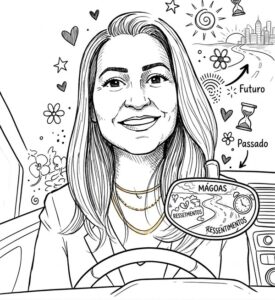 The answer is simple yet powerful: because what lies ahead of us is infinitely more important than what we left behind.
So many people spend their lives stuck in reverse, dwelling on the past, holding onto grudges, harbor resentment, or blaming past events for their current circumstances and lack of opportunities.
In those moments, I love to recall Winnie the Pooh’s wise words: “I always get to where I’m going by walking away from where I’ve been.” To me, this lesson holds two vital meanings: I can only reach my desired destination by moving in its direction and, above all, by having the courage to leave my past behind.
Combining Pooh’s wisdom with the car analogy, I understand that the past has its place. Just like a rearview mirror, we only need to glance at it briefly — just enough to acknowledge the journey we’ve traveled, spot potential hazards around us, and proceed safely. However, it is the windshield that reminds us where our main focus belongs.
If you want to reach the podium and celebrate your victories, you must look forward. Your past isn’t meant to define you, but to refine you.
In the GTD method, the fifth and final step is Engage / Execute. And that is our windshield: wide, clear, and massive, because the present moment is where your full attention needs to be right now. It is conscious action, free from distractions.
The previous steps — especially Step 4 (Review) — act as the rearview mirror. It’s intentionally small for a reason: it’s only meant for quick, periodic checks. If you try to drive through life staring fixedly at your rearview mirror, dwelling on what you didn’t do or stressing over your entire to-do list, a crash is inevitable.
So, if your plan gets derailed at any point and you don’t progress as scheduled, take a deep breath. Don’t panic, and don’t blame yourself. Losing a minute in life isn’t a sign of failure; it’s a sign of caution and discernment.
Remember: the true goal of an organization isn’t to produce more per hour, but to protect your mental, physical, and emotional health. Adjust your route, look through the windshield, and keep driving forward — because the best part of your journey starts right now.