


How many times have you done something wrong thinking you were doing it right? Or how many times have you used a product or gadget thinking you were using it correctly, until someone came along and pointed out your mistake? I could sit down with you for an afternoon and share my own confessions; we would certainly run out of time. We might even have to extend our chat through dinner or reschedule for another coffee.
After more than half a century of life, I realized I had always been misusing a famous Brazilian expression: “Chutar o pau da barraca” (literally translated as “to kick the central tent pole”). And to think I use it all the time! The truth is, I also discovered I wasn’t entirely wrong either. It makes me wonder if, when we act mistakenly thinking we are doing the right thing, that “error” isn’t actually the exact stumble we needed to learn how to do it right.
When researching the phrase, I discovered it has a very literal and visual origin, born from how old canvas structures worked. Traditional tents — whether in open-air markets, campsites, or circuses — rely on a central support structure made of wooden stakes or poles (the “tent poles”) to stay upright. This central pole bears the entire weight of the fabric and the frame under tension.
So, when someone, consumed by anger or frustration, kicked that central support beam, the entire structure would collapse immediately and violently, scattering canvas, objects, and chaos all around.
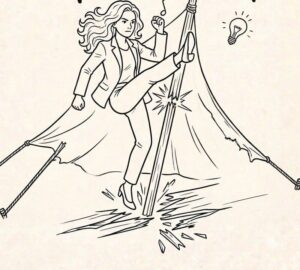 Over time, the image of a collapsing tent became a cultural metaphor in Brazil for moments when someone completely loses their patience, similar to the American concept of “burning bridges,” “throwing a tantrum,” or “flipping the table.” For others, it means giving up on maintaining appearances or keeping order. “Enough!” “I’m done!” Some use it when they throw in the towel altogether, creating an irreversible mess just to vent their frustration. The tent doesn’t just fall down — there’s no way to put it back up.
What I didn’t know was that by misinterpreting the expression, I had created something bigger in my own mind. To me, the idea was never about throwing a fit; it was associated with an “all or nothing,” “go all in,” and “come what may” attitude. In other words, deciding to take a drastic, bolder step and owning whatever total risk came with the situation!
You know that moment when things aren’t going the way we hoped? When hope no longer reaches us, but instead exhausts us? When patience has crossed all limits and we realize that getting angry won’t do any good? That’s when I say, “That’s it! I’m kicking the tent pole. Let the chips fall where they may!”
While most people use “kicking the tent pole” for the moment patience runs out and everything crashes down, the expression gained a sense of pure audacity for me. The gesture simply means breaking the pattern, risking it all, taking a leap of faith, and going for “do or die.”
To me, kicking the tent pole isn’t about acting recklessly without weighing the pros and cons. It’s that turning point where doubt ends and action begins — whether the world falls apart or not! It’s when you realize something has reached its limit and, instead of waiting for opportunities, you create one. You are no longer just the reader; you become the author of your own story.
Whether you made a mistake trying to get it right or out of carelessness, it doesn’t matter anymore. It happened! The important thing is to break through the limits that keep you trapped in doubt. Of course, we don’t want to fail or go through an embarrassing moment, but postponing decisions might be the very thing driving anxiety and stress.
Go ahead and kick that tent pole! Break down the barriers that keep you from finding out whether it will work or not. If it falls, shake off the dust and keep going. A temporary collapse, maybe, but living suffocated under the canvas of hesitation, never!
If the week’s plan or routine got out of control, or if the fear of making a mistake paralyzed you, understand this: the problem isn’t the tent falling; it’s spending your whole life without the courage to pitch it again. Simplifying is about stopping negotiations with fear and taking ownership of your own path.
How about you? Are you going to stay trapped under the canvas of doubt, or are you going to have the audacity to kick the tent pole today?